market updates · Uncategorized

Why the 2026 Housing Market Still Looks Strong


If youโ€™ve been following national real estate headlines, you might think the housing market is either slowing to a crawl or on the brink of collapse. But here in Minneapolisโ€“St. Paul, that narrative doesnโ€™t quite fit.

Economists that look at real estate markets nationwide agree!

What weโ€™re experiencing right now isnโ€™t a boom or a bust. Itโ€™s something we havenโ€™t seen in years: a more normal housing market. And when you zoom out and look at the bigger picture, that normalcy may actually set Minneapolis up for a strong 2026.

What the Minneapolis Housing Market Looks Like Right Now

This past year has been briskโ€”but not chaotic. Homes arenโ€™t selling in minutes anymore, and thatโ€™s an important shift.

  • The average home is spending about 39 days on the market. This is consistent with past years.
  • Interest rates have largely held steady in the mid-6% range for 30-year fixed mortgages
  • Buyers have more breathing room, and sellers are still seeing solid demand

When you compare todayโ€™s market to the frenzy of 2020โ€“2022, it feels very different. But when you compare it to 2019, it starts to look familiar. Balanced. Measured. Functional.

Thatโ€™s not a bad thing.

Why Minneapolis Keeps Ranking as a Top Growth Market

Despite higher interest rates and a slower pace, Minneapolis continues to show up on top 5 growth market lists from major real estate organizations like Zillow, Redfin, and the National Association of Realtors.

So why does this metro keep punching above its weight?

1. Relative Affordability for a Major Metro

For a city of this size, Minneapolis remains comparatively affordable. We offer strong job markets, respected healthcare systems, major universities, and vibrant arts and cultural amenitiesโ€”without the price tags seen in many coastal cities.

That affordability continues to attract buyers from higher-cost regions of the country.

2. Climate Stability Is Becoming a Housing Factor

While not always part of traditional real estate conversations, climate resilience is increasingly influencing long-term housing demand.

The Upper Midwest is more insulated from many of the climate-related disasters impacting other parts of the U.S., and that stability is quietly shaping migration patterns. Over time, this contributes to sustained housing demand.

3. Ongoing Housing Shortages

Housing inventory remains tightโ€”and thereโ€™s little indication that this will change quickly.

  • New construction remains expensive
  • Building material costs continue to be impacted by tariffs
  • Labor shortages are worsening due to immigration crackdowns that reduce the availability of skilled workers on job sites

Fewer homes being built means continued pressure on prices, even in a calmer market.

What to Watch Heading Into 2026

No market is without risk, and itโ€™s important to stay realistic.

Employment trends matter, and national unemployment rates have been increasing. A weakening job market can always influence buyer confidence. That said, real estate is deeply local.

We remain below national rates!

When you look specifically at Minneapolis and the broader Upper Midwest, the fundamentals remain strong: stable demand, limited supply, relative affordability, and long-term desirability.

Why a โ€œNormalโ€ Market Is Actually Good News

This isnโ€™t the frenzy of 2021, and it isnโ€™t a market falling apart either.

Itโ€™s a steadier environment where:

  • Buyers can make thoughtful decisions
  • Sellers still benefit from constrained inventory
  • Pricing is supported by fundamentals rather than hype

For people who understand the local market, this kind of balance can be incredibly healthyโ€”especially as we look toward 2026.

Final Thoughts

If youโ€™re buying, selling, or considering a move to Minneapolis, understanding local conditions matters far more than national headlines. The Twin Cities market continues to show resilience, stability, and long-term promiseโ€”even as other regions experience very different outcomes.

As always, all real estate is local. And right now, Minneapolis is quietlyโ€”and confidentlyโ€”holding its ground.

Home Buying · home selling · Uncategorized

Why Working With a Solo Real Estate Agent Beats a Big Team โ€” Every Time

If youโ€™ve ever contacted a real estate agent because you loved their marketing, their videos, or their personalityโ€ฆ only to suddenly find yourself working with someone entirely different, youโ€™re not alone.

This is one of the most common complaints I hear from buyers and sellers relocating to โ€” or moving within โ€” the Twin Cities. They thought they were hiring that agent, but instead they got handed off to someone on their team. Often, itโ€™s a newer agent still gaining experience.

So letโ€™s talk about it:
Should you work with a solo agent or a real estate team?
And what does that experience actually feel like as a client?

As a solo Twin Cities Realtor who handles every part of the process myself, Iโ€™ll tell you what you can expect โ€” and why this choice matters more than most buyers and sellers realize.


What Really Happens When You Hire a Real Estate Team

Real estate teams are built for one thing: volume.
The larger the team, the more clients they can run through the system. Thatโ€™s great for themโ€ฆ not always great for you.

Hereโ€™s the typical experience:

  • You reach out to โ€œTop Agent Jane,โ€ the one all over YouTube and Instagram.
  • Jane doesnโ€™t personally take new buyer calls.
  • Your information goes to their โ€œbuyer specialistโ€ โ€” a newer agent learning on the job.
  • That buyer agent might not have the negotiation experience you expected.
  • The lead agent may never show up at a showing, a strategy call, or even your closing.

Thereโ€™s nothing wrong with new agents โ€” everyone starts somewhere!
But you didnโ€™t choose that person.
You chose the face of the brandโ€ฆ and got someone else.

For many people, this feels like a bait-and-switch โ€” even if it wasnโ€™t intentional.


What Itโ€™s Like to Work With a Solo Agent

When you work with a solo agent, the experience is entirely different.

You get the person you contacted. Every step of the way.

I know your timeline.
I know your story.
I know your preferences, your deal-breakers, your stress points, and your goals.

And because Iโ€™m the one taking every call, attending every showing, writing every offer, and negotiating every term, nothing gets lost in translation.

There is no hand-off.
No โ€œlet me check with the team.โ€
No confusion about whoโ€™s managing what.

Just one dedicated professional who truly knows your transaction from the inside out.


Why Experience Matters โ€” Especially in Negotiation

One of the biggest advantages of working with a seasoned solo agent is negotiation skill.

Many team-based agents specialize only in buyers or only in sellers.
That sounds goodโ€ฆ until you realize they donโ€™t understand what motivates the other side.

When your agent works with both buyers and sellers โ€” and manages every part of the deal personally โ€” they have a complete understanding of:

  • how sellers evaluate offers
  • what buyers notice (and what they donโ€™t)
  • how listing agents prioritize communication
  • what makes an offer stand out
  • what terms truly matter in todayโ€™s Twin Cities market

You get strategy, not just logistics.


A Solo Agent Learns YOU โ€” Not Just Your File

Real estate is deeply personal.
Buying or selling a home is emotional, stressful, exciting, and sometimes overwhelming.

When youโ€™re passed between team members, the experience can start to feel transactional.

When you work with one dedicated agent, you get something simpler and more meaningful: trust.

You donโ€™t have to re-explain yourself.
You donโ€™t have to wonder whoโ€™s calling.
You donโ€™t have to worry that someone new has taken over your file.

Instead, you get consistency, clarity, and confidence.


Soโ€ฆ Team or Solo? What Should You Choose?

Real estate teams work well for highly structured, high-volume business models.
Some consumers prefer that.

But if you value:

โœ” personal communication
โœ” consistent guidance
โœ” a seasoned professional overseeing everything
โœ” relationship over volume
โœ” thoughtful, strategic, experience-based advice

โ€ฆthen a solo agent might be exactly what youโ€™re looking for.

And if youโ€™re relocating to Minnesota โ€” or moving within Minneapolis/St. Paul โ€” having one dedicated guide makes the process so much easier.

market updates · Uncategorized

Minneapolis Real Estate Market Update | October 2025

If youโ€™ve been following national real estate news lately, youโ€™ve probably seen some dramatic headlines: โ€œHome Prices Are Falling!โ€ or โ€œThe Housing Market Is in Decline!โ€
And while thatโ€™s true for many cities across the countryโ€ฆ itโ€™s not the story here in Minnesota.

Here in the Twin Cities, the housing market continues to hold steady โ€” and even grow โ€” while other once-red-hot markets cool off. Whatโ€™s really happening as we head into fall 2025?


๐Ÿ“‰ The National Picture: Markets Cooling Down

Across the U.S., many of the cities that were booming in 2021 and 2022 are now seeing prices soften and homes sit longer on the market.
A recent report listed the top 10 cities with falling home prices (per redfin), and they included:

  • Miami
  • Austin
  • San Diego
  • Richmond, VA
  • Boston
  • San Antonio
  • Dallas
  • Denver
  • Phoenix
  • Sacramento

These are all markets that experienced major appreciation during the pandemic โ€” and now, theyโ€™re seeing the other side of that cycle.


๐Ÿ“ˆ The Minneapolis Story: A Very Different Trend

Meanwhile, here in the Twin Cities, things look much more balanced โ€” and frankly, healthy.

The median price for previously owned single-family homes in our 7-county metro area is up 5% year-over-year, sitting at around $420,000.

Even more encouraging, new construction homes โ€” which saw some price dips last year โ€” have rebounded. The median price for a new construction single-family home is up 5.5%, landing just under $600,000.

So while national headlines sound gloomy, the Minneapolis market remains strong, steady, and appreciating at a sustainable pace.


๐Ÿ  Inventory: The Most Weโ€™ve Seen in Years

Letโ€™s talk about inventory โ€” because thatโ€™s where weโ€™re really seeing movement.

As of early October, there are just over 8,000 active listings across the metro.
For comparison:

  • October 2024: 7,700 active listings
  • 2020: 6,000 active listings
  • 2019 (our last โ€œnormalโ€ year): 9,400 active listings

So while weโ€™re not back to pre-pandemic levels, itโ€™s a noticeable increase.
Every one of the seven metro counties now has more than two months of inventory, with Anoka County being the tightest at exactly two months.

This shift toward balance is a good thing. It means buyers have more choices, sellers need to be more strategic, and overall, the market feels more normal again.


๐Ÿ’ธ Price Reductions on the Rise โ€” But Sales Are Still Strong

Another sign of a normalizing market? Price reductions.

Across the Twin Cities, weโ€™re seeing roughly 1,000 price reductions every single day on active listings.
That doesnโ€™t mean homes arenโ€™t selling โ€” it just means sellers and agents are adjusting to find that sweet spot where supply and demand meet.

When a home is priced correctly and shows well, it still sells. But gone are the days of โ€œlist it Friday, sold by Monday with 12 offers.โ€ This is the kind of market where experience, pricing strategy, and presentation really matter.

Despite more price adjustments, weโ€™re still ahead of last year in the number of total homes sold โ€” proof that this is not a stalled market, just a balanced one.


๐Ÿ•ฐ Is It Smart to Try to โ€œTime the Marketโ€?

I get asked this a lot:
โ€œShould I wait to buy until prices drop?โ€
โ€œShould I hold off on selling until things heat back up?โ€

Hereโ€™s the thing โ€” unless you have insider information the rest of us donโ€™t, itโ€™s nearly impossible to time the market perfectly.

Real estate is hyper-local. Itโ€™s not even just city by city โ€” itโ€™s neighborhood by neighborhood, sometimes block by block.

Thatโ€™s why I always tell my clients: look at your personal timing, your finances, and your goals. Then make decisions based on that, not just the national headlines.


๐ŸŒณ The Bottom Line: Minneapolis Is Steady and Strong

While other parts of the country are feeling the chill, the Twin Cities real estate market continues to show quiet confidence.

We have:
โœ… Rising prices (5โ€“5.5% year-over-year)
โœ… Growing inventory but still healthy demand
โœ… More balance between buyers and sellers
โœ… A steady pace of sales

Itโ€™s not a โ€œboomโ€ or a โ€œbust.โ€ Itโ€™s a sustainable, smart market โ€” and thatโ€™s exactly where you want to be.

If youโ€™d like a more detailed look at whatโ€™s happening in your specific neighborhood or suburb, reach out! I love helping people who meet me on YouTube and my blog understand the real numbers behind the market.

And if youโ€™re thinking about moving to Minnesota, grab my Free Relocation Guide โ€” itโ€™s linked below and packed with everything you need to know about living in the Minneapolisโ€“Saint Paul area.


๐Ÿ‘‹ Iโ€™m Mary Schumann, Realtor in the Twin Cities metro.
If you found this helpful, subscribe to my YouTube channel or reach out directly โ€” Iโ€™d love to help you navigate our Minnesota market with confidence.
๐Ÿ“Free Minnesota Relocation Guide: https://maryschumann.kw.com/twin-cities-relocation-guide

Minnesota · Uncategorized

Minneapolis Named the Happiest City in the U.S. โ€“ Hereโ€™s Why Youโ€™ll Love Living Here


Can you believe Minneapolis is the happiest city in the United States? According to Travel + Leisure, our city outranked some of the most well-known places in the country when it comes to happiness.

But what makes Minneapolis so special? And if youโ€™re thinking about moving to Minnesota, is this the right place for you? Letโ€™s break it all downโ€”why people love living here, what makes Minneapolis stand out, and why so many people are choosing to call the Twin Cities home.


Why Minneapolis is Americaโ€™s Happiest City

When people think about moving to Minnesota, the first thing they picture is cold winters. And while, yes, we get snow, what many donโ€™t realize is that Minneapolis thrives year-round. The combination of a strong job market, endless outdoor activities, a rich arts and culture scene, and affordable real estate makes this city a fantastic place to live.
Hereโ€™s why so many people are making the move to Minneapolis.


1. Incredible Green Spaces & Outdoor Life

One of the biggest reasons people love living in Minneapolis is access to nature. In fact, Minneapolis consistently ranks as one of the best cities in the U.S. for parks and outdoor recreation.

๐Ÿž๏ธ 180+ parks, 22 lakes, and miles of trails โ€“ perfect for biking, walking, and jogging
๐Ÿšฃ Year-round outdoor fun โ€“ summer means kayaking, paddleboarding, and hiking, while winter brings cross-country skiing, ice fishing, and even pond hockey
๐ŸŒณ The Minneapolis Chain of Lakes โ€“ a must-see spot where you can enjoy waterfront views, picnic areas, and scenic trails

If you love outdoor activities but still want the perks of a vibrant city, Minneapolis offers the best of both worlds.


2. Booming Job Market & Economy

If youโ€™re moving to Minnesota for work, youโ€™ll find plenty of opportunities here. Minneapolis has a thriving job market, with Fortune 500 companies and innovative startups alike.

๐Ÿข Big employers include Target, Best Buy, Medtronic, 3M, and General Mills
๐Ÿ’ผ Growing industries: Tech, healthcare, finance, and creative services
๐Ÿ“ˆ Low unemployment rates and strong wages compared to national averages

Minneapolis has one of the best economies in the Midwest, making it a great place to build your career and enjoy a strong work-life balance.


3. Arts, Culture, & Food Scene

If you think the Midwest is all farmland and small towns, think again. Minneapolis has an amazing arts and entertainment scene that rivals cities twice its size.

๐ŸŽญ Theater lovers rejoice! โ€“ Minneapolis has more theaters per capita than any U.S. city except New York
๐ŸŽธ Live music and nightlife โ€“ From First Avenue (where Prince made history) to local jazz clubs, music lovers will always find a show to enjoy
๐Ÿ” Foodie paradise โ€“ From craft breweries to James Beard Award-winning restaurants, the cityโ€™s food scene is a hidden gem

Whether you’re into theater, music, or dining out, Minneapolis has something for everyone.


4. More Affordable Than Other Major Cities

Compared to cities like San Francisco, Seattle, or Austin, Minneapolis is much more affordableโ€”especially when it comes to housing.

๐Ÿก Lower home prices than coastal cities โ€“ You get more space for your money
๐Ÿš— Shorter commutes โ€“ No soul-crushing traffic like in L.A. or NYC
๐Ÿ’ฐ Lower cost of living โ€“ More affordable groceries, dining, and entertainment

If youโ€™re considering moving to Minneapolis, now is a great time to buy a home. Whether you want a downtown condo, a charming bungalow, or a new construction home in the suburbs, there are great options at a price point that wonโ€™t break the bank.


So, Is Minneapolis Right for You?

If youโ€™re looking for a city with a strong sense of community, thriving job opportunities, affordable housing, and endless outdoor activities, and a generally HIGH quality of life, then Minneapolis might be the perfect place for you.

And if youโ€™re ready to start exploring homes in Minneapolis or the Twin Cities area, Iโ€™d love to help! As a local real estate expert, I work with buyers relocating to Minnesota all the time. Whether you have questions about the market or need help finding the right neighborhood, Iโ€™m here to guide you every step of the way.

๐Ÿ“ฉ Thinking about making the move? Contact me today!


Living in Minneapolis · Neighborhood Tours · Uncategorized

Why Live in Fulton, Minneapolis? A Guide to This Charming, Walkable Neighborhood

If youโ€™re looking for a walkable, charming, and convenient neighborhood in Minneapolis, Fulton should be on your radar. Located in the southwest part of the city, this neighborhood offers beautiful historic homes, easy access to nature, and a fantastic local dining and shopping scene. Whether you’re drawn to Lake Harriet, Minnehaha Creek, or the convenience of 50th & France, Fulton has a lot to offer.

Letโ€™s dive into what makes Fulton one of the most desirable neighborhoods in Minneapolis!


Proximity to Lake Harriet & Minnehaha Creek ๐ŸŒณ๐Ÿšถโ€โ™€๏ธ

One of the biggest perks of living in Fulton is how close you are to Lake Harriet. The lake is one of Minneapolisโ€™ most scenic spots, offering:

  • Walking and biking trails ๐Ÿšดโ€โ™‚๏ธ
  • Public beaches ๐Ÿ–๏ธ
  • A bandshell with live music in the summer ๐ŸŽถ
  • Beautiful views year-round ๐ŸŒ…

But thatโ€™s not allโ€”just south of Fulton, youโ€™ll find Minnehaha Creek, a picturesque waterway with a paved trail that connects to the Mississippi River. Whether youโ€™re a cyclist, runner, or just enjoy peaceful walks, Fulton puts you right in the middle of it all.


Historic Homes & New Construction Trends ๐Ÿกโœจ

Fulton is known for its early 1900s homes, including Craftsman bungalows, Tudors, and other historic styles that give the neighborhood character. However, because Fulton is so desirable, many smaller homes are being torn down and replaced with larger, modern builds.

This means homebuyers have options:

  • Classic charm โ€“ If you love historic homes, Fulton has plenty to choose from.
  • New construction โ€“ If you prefer a modern layout with new finishes, there are opportunities for that too.

With a mix of old and new, Fulton offers a unique blend of history and modern convenience.


Home Prices: A Bargain Compared to Linden Hills? ๐Ÿ’ฐ๐Ÿ“‰

While Fulton is a sought-after neighborhood, it actually offers more value compared to its neighbor, Linden Hills. Hereโ€™s how they compare:

  • Fultonโ€™s average home price: $690,000
  • Linden Hillsโ€™ average home price: $982,000

For buyers looking to be near Lake Harriet and 50th & France, Fulton provides a more affordable way to enjoy everything this area has to offer.


A Highly Walkable Neighborhood with Great Restaurants ๐Ÿฝ๏ธโ˜•

One of Fultonโ€™s biggest selling points is walkability. Whether youโ€™re heading out for coffee, a bite to eat, or boutique shopping, thereโ€™s plenty to explore right in the neighborhood or just beyond its borders.

Neighborhood Favorites:

  • Brodersโ€™ Pasta Bar โ€“ Some of the best Italian food in the Twin Cities. ๐Ÿ
  • Tinto Kitchen โ€“ A Latin-inspired eatery with delicious flavors. ๐ŸŒฎ
  • Colita โ€“ Inventive Mexican cuisine and craft cocktails. ๐Ÿน
  • 50th & France โ€“ A shopping and dining hub with even more options. ๐Ÿ›๏ธ

Having these amazing restaurants and shops within walking distance adds to the charm and convenience of living in Fulton.


Convenience: Easy Access to Downtown & MSP Airport ๐Ÿš—โœˆ๏ธ

Fulton is in a prime location for commuters and travelers alike. You can get to:

  • Downtown Minneapolis โ€“ About 15 minutes by car.
  • Minneapolis-St. Paul International Airport (MSP) โ€“ Around 15-20 minutes away.

Whether you work in the city or travel frequently, Fulton offers easy access to major destinations without sacrificing neighborhood charm.


Grocery Stores & Essentials Nearby ๐Ÿ›’

Living in Fulton means having several grocery stores within a short drive:

  • Lunds & Byerlys (50th & France) โ€“ A high-end grocery store with excellent selection.
  • Kowalskiโ€™s Market (Kenny Neighborhood) โ€“ A great spot for fresh, local ingredients.
  • Aldi (Penn Ave, Richfield) โ€“ Budget-friendly shopping nearby.
  • Whole Foods (Edina) โ€“ For organic and specialty foods.

With multiple options, grocery shopping is both easy and convenient in this area.


Schools: Top-Rated Public Education ๐ŸŽ“

For families moving to Fulton, the local public schools are a major advantage. The neighborhood is served by:

  • Lake Harriet Lower & Upper Schools (Elementary)
  • Southwest High School โ€“ Consistently ranked among the best high schools in Minneapolis

These schools have strong academic programs and great community support, making them a big draw for families considering a move to the area.


Final Thoughts: Is Fulton Right for You? ๐Ÿค”

With its proximity to Lake Harriet, historic charm, walkability, and great schools, itโ€™s easy to see why Fulton is one of the most desirable neighborhoods in Minneapolis. Whether youโ€™re looking for a classic early 1900s home or a new build, this neighborhood offers options for every lifestyle.

If youโ€™re thinking about buying a home in Fulton or anywhere in the Twin Cities, Iโ€™d love to help! Feel free to reach out with any questions.

๐Ÿ“ฉ Contact me today to learn more about real estate in Minneapolis!


Did you enjoy this post? Share it with someone whoโ€™s considering a move to Minneapolis! ๐Ÿš€

#FultonMinneapolis #MinneapolisRealEstate #LakeHarrietHomes #TwinCitiesLiving #MovingToMinneapolis

Home Buying · Living in Minneapolis · Uncategorized

Think Twice Before Buying These Types of Homes

And if thinking twice doesn’t do it, think a few more timesโ€”because you may be buying a house you’ll be stuck with for a LONG time.

I’m Mary Schumann, a realtor in the Minneapolis area. I help a LOT of buyers find the right home here. I’ve seen horror stories, analyzed inspection reports, and run the data on enough houses to confidently tell you to stay away from the following types of homes. Some of these tips may seem like common sense, but circumstances can sometimes push buyers to overlook red flags. Don’t be that buyer!


1. Homes With Obvious Flaws or Hazards

If a home has an obvious flaw that can’t be fixedโ€”STOP and reconsider. Examples include:

  • Located on a busy street
  • Backing up to a railway
  • Next to a run-down mobile home park

The number one rule in real estate is location, location, location. If you buy in a noisy or undesirable area, you’ll limit your resale options significantly. Busy streets, railways, and unattractive neighbors often scare off buyers with kids or pets.

Pro Tip: Itโ€™s often better to buy the worst home in the best neighborhood than the best home in a questionable location.


2. Homes Without Basements

In Minnesota, basements are essential. We get tornadoes here, and having a safe place to go during severe weather is key. Basements also provide:

  • Extra storage
  • Space for a family room or workout area

Most buyers expect a basement, so skipping one could hurt your property value.


3. Homes With Water Problems

Watch out for homes at the bottom of a slope or in flood zones. These can lead to:

  • Damp basements
  • Water damage and mold

Look for signs of water staining or dampness, and make sure the home has a sump pumpโ€”a good sign the seller has mitigated any water issues.

Flood Zones Tip: Minnesota does well with water management, but always check flood maps if you’re near rivers or creeks.


4. Homes With Steep or Long Driveways

Minnesota winters mean snow and iceโ€”and neither is fun on a steep or long driveway. Problems include:

  • Cars getting stuck or scraping low-clearance vehicles
  • Slipping on ice when walking up or down

Sunlight Tip: Driveways facing south or west get more sun, which helps melt ice and snow faster.


5. Poor-Quality New Construction Homes

Donโ€™t get distracted by fancy finishes like granite countertops. Instead, focus on:

  • Durability of floors and carpet padding
  • High-quality mechanicals (furnace, AC, etc.)
  • Reputable builders with strong reviews

Minnesota has a 1-2-10 warranty on new construction:

  • 1 year: Full coverage
  • 2 years: Mechanical systems
  • 10 years: Structural defects

Get a home inspection in the 11th month of your warranty to catch issues early.


6. Older Homes With Bad Roofs

Insurance companies may refuse coverage if a roof is in poor condition. Always check roof age and quality before buying an older home.


7. Homes at Dangerous Intersections or Curves

Avoid homes on T-intersections or tight curves. These locations often:

  • Attract traffic accidents
  • Shine headlights into your windows at night

8. Homes With HOA Restrictions

While Minnesota’s HOA rules are often less strict than other states, review them carefully. Minnesota law gives buyers a 10-day review period for HOA documents, including:

  • Rules and regulations
  • Budgets and expenditures

You can cancel your offer and get your earnest money refunded during this period if you donโ€™t like what you see.


Final Advice: Donโ€™t Skip Inspections

Yes, inspections are expensive, but they can save you from making costly mistakes. A high-quality inspector can uncover issues you may not be able to negotiate or fix later.


Work With a Realtor Who Tells It Like It Is

Thinking about buying a home? Find an agent who gives you honest guidance. My role is to arm you with the information you need to make smart decisions.

If you have questions, reach out! I love hearing from people who find me on online or on YouTube.

Uncategorized

10 best public school districts in the Minneapolis St Paul metro!

Today, I’m diving into the top 10 public school districts in the Minneapolis-St. Paul metro area according to Niche.com. This is a crucial topic for families considering a move to the Twin Cities metro.

School choice is a very personal thing, and while these schools have ranked highly on Niche.com, it’s important to visit the schools and ask questions pertinent to YOUR child, ensuring the decision fits your family best.

Minnesota stands out in its commitment to education. In May 2023, the state passed a massive $2.2 billion funding increase for public schools. This means the total budget now exceeds $23 billion dollars, Minnesota is dedicated to providing top-notch educational opportunities. The governor has publicly stated his goal of making Minnesota a great place to raise a family.

I feel like David Lettermanโ€ฆ

At #10!ย  Mahtomedi Public Schools. This is a smaller district on the Northeast side of the cities with only about 3200 students in total. The student to teacher ratio is 24:1 and it ranks highly in academics. It does have a โ€œgifted programโ€ and AP courses are offered.

At #9 is Rosemount-Apple Valley-Eagan public schoolsโ€“ This school district has a higher ranking in diversity of student population, the student teacher ratio is lower according to Niche.com ย stating that the ratio is 17 students to 1 teacher. This is an ENORMOUS school district with a lot of schools and almost 30,000 students. Itโ€™s located south of the cities. It has just about everything due to itโ€™s large size.

At #8 Mounds View โ€“ Mounds view has a similar student teacher ratio as R-AV-E, but a much smaller student population at just under 12,000 students. Mounds view offers special ed, AP classes and a gifted program.

#7 Lakeville Schoolsโ€“ Lakeville is a smaller district with about 11,500 students and a 17:1 student teacher ratio. Lakeville is a growing community, there is a lot of new construction in this area, this formerly fairly rural area is becoming quite suburban. I do have a video about Lakeville that you can check out if you’d like. I have a playlist of MANY of the suburbs in the Twin Cities so you can check those out if youโ€™re curious about various areas.

#6 Hopkins this is a small district of only about 7,000 students and it has a great student teacher ratio at 15:1. This is a community to consider if you like a small town feel but also want to be close to the actual city. I did a video on Hopkins and I will link to it here.

#5 Orono โ€“ this is a very small school district of less than 3000 students and is in one of the wealthier areas of the metro, bordering on Lake Minnetonka in places. This district scores well on Niche for everything except diversity.

#4 Edina โ€“ This a district of 8,400 students in a close in suburb of the Metro. I have done several videos showing neighborhoods in Edina, you can find them in my playlist and Iโ€™ll link to Indian Trails which is very close to the High School. I encourage you to look at the web sites of the various districts to see what they are highlighting โ€“ Edina has a VERY large offering for a district of this size.ย  From the school district: โ€œEdina Public Schools offers opportunities for students to deeply explore their interests, experience real-world learning, and creatively innovate. PreK-12 STEAM, travel-based learning, language immersion, talent development, and a virtual pathway are a few of the ways we individualize learning.โ€

#3 Eden Prairie โ€“ Eden Prairie offers a Spanish Immersion school as one of its options and also has gifted, AP and special ed. It has about 9,000 students and they say they have a 15 to 1 student to teacher ratio. This district is in an in demand suburb on the west of side of Minneapolis. From the school district: โ€œWe believe it is our purpose to create an environment of care and support where each student is inspired every day to recognize their skills and motivations, take ownership of their learning and explore their interests and passions.โ€ I sat in on a presentation from the Eden Prairie schools and they seem to emphasize having kids that will be prepared to make decisions about what they want to do with their lives when leaving high school. For an overview of Eden Prairie you can check out my video profile of that suburb.

#2 Minnetonka โ€“ย ย the district serves 10,900+ students and is the most sought-after district for open enrollment in MN with nearly 3,600 nonresident students. I believe that most of these non-resident students open enroll into Perpich Center for the Arts which is a public arts focused high school in Minnetonka. (I also did a video on open enrollment!) Minnetonka offers K-12 Chinese and Spanish Immersion, K-5 computer coding, AP and IB courses, collaborative research, advanced professional studies, online learning and award-winning arts and music programs.ย Ninety-eight percent of seniors graduate, 90% are college-bound. I do have a video for Minnetonka, too!โ€‚

#1 Wayzataโ€”The number one school district perย niche.comย is Wayzata schools. I hear from a lot of parents that want to get into this district because they have a good reputation and offer programs for special ed, AP and gifted. This district is large geographically and has 8 suburbs that feed into it on the north western side of the metro. It does have about 13,000 students.

An important aspect to understand is how school funding, often tied to property taxes, affects resources. Schools in areas with higher home prices (like Wayzata) generally have more resources. However, this doesn’t mean schools not on this list aren’t great options. The Twin Cities boast many excellent public schools.

Remember, if public schools aren’t the right fit for your family, the Twin Cities also offer a robust system of private schools, including religious and independent secular schools. Choosing the right school is about finding a place where YOUR child will thrive and grow.

Thank you for joining me! I love to talk to people that meet me on YouTube or the blog so please reach out with any questions or experiences you have with these schools.

Home Buying · Home equity · home selling · market updates · Uncategorized

Opportunities for buyers? Twin Cities real estate market update!

What is happening in the Minneapolis areaย real estate market? I’ve been following several metrics over the pastย few years and there are a few that really stand out to me as indicative of how the market is doing, not just PRICE but what kinds of terms are included in winning offers and I will let you know which terms are revealing the current state of the market here.ย ย 

I’m keeping my finger on the pulse of what is happening in the Twin Cities metro real estate market so you can be an informed buyer or seller.

The number one question that most people have about homes is whether or not prices are falling? I keep hearingย this and for the purposes of this discussion I’m just going to look at the 7 county metro around Minneapolis and St. Paul and we can check the different housing types. Theย firstย is the most popular -SINGLE FAMILY HOMES.ย  When I was digging into data for this update I decided to look at it over the past year and the past 10 years so that I can show you trend lines for both.ย  I’m also going to differentiateย by new constructionย and previously owned because new construction is at a vastly different price point as a whole.ย 

Prices & time on market for existing homes

Metrics that I didn’t talk about in the video are how long houses are staying on the market these days. I do see houses sitting for quite a long time in certain areas and price points but the official numbers are charted here. The graph gives the impression of a big increase in time, but real numbers equate to only 3 more days.

New Construction

I’ll talk about pricing but for new construction I see a lot of opportunity for buyers here! Why? Builders have a lot of inventory right now. They have completed homes as well as homes that are underway with completion dates coming up. They need to get these homes off their books so they can continue to build and the interest rates have slowed things down for everyone, but the big builders are offering rate buy downsย for buyers right now along with all kinds of other incentives, from appliance packages to closing costs.

Things to consider are that these homes are mainly being built inย 3rd ring suburbs and exurbs so if proximity to the city is important you’re less likely to be able to get a new build – or at least one with a big builder that can offer these incentives. There are customย builds on lots here and there in the city.ย 

You’ll see a slight dip in median price ($5000) from the beginning of the year.ย  I have read in multiple sources that they estimate that it would take 10 years of building for the builders to catch up to demand for homes due to the after effects of the housing recession in 2008. We are still that far behind. New construction is showing over 6 months worth of supply but take this with a grain of salt because builders list homes that are TO BE BUILT – so they aren’t existing yet – along with those that they have ready for a buyer to move into.ย 

New construction supply shows a buyers market! I haven’t seen this kind of number in a VERY long time. Ever?ย 

Things are different when you look at previously owned homes. It is still a sellers market, although not the insane sellers market of a year or 2 ago. Homes still get multiple offers, theย market is still moving just not at a runaway pace. Previously owned single family homes areย sitting at about 1.3 months supply. So you can see the difference here.ย 

WHY is it a seller’s market for existing homes and a buyer’s market for new constructions?

What leads to this? 80% of people with a mortgage on their home are paying less than 5% interest, 50% of them have a rate at less than 4%, they need a bigย incentive to list their homes and buy a different home with a mortgage at a higher rate. This really is one of those cases where as usual, of you have a good budget you are at an advantage because you can buy new construction and take advantageย of the market and the incentives whereas those 2 things don’t exist as much for existing homes, prices are lower as a median but supply is lower too and you don’t get the builder buy downs. But you also don’t have to pay for a deck or the multitude of finishing touches that need to be added to new construction.ย 

Price reductions

Housing inventory is dropping now as we get into the winter and holiday time, but the other thing that is slowing is PRICE REDUCTIONS – the percentage of them is reduced by about half of what it was 1.5 to 2 months ago, from 14% of listings to about 7%. Maybe agents and sellers are pricing correctly now, or maybe they understand that they may spend more than 5 minutes on the market?ย 

Bank owned homes

Another statistic of note are the number of distressed or bank owned properties. We still have fewer than 100 listed out of about 6200 active listings. Less than 1.5%, other markets in the US are notย faring as well. People here are still meeting their mortgage payments.ย 

Offer terms that show a big shift

OK – a couple of other things that really stand out to me – the first is that sellers are contributing to buyers closing costs 43% of the time! that’s the highest percentageย I can remember seeing. People including appraisal gap language on there offers has almost disappeared (although escalation clauses are still being included) but this makes sense when you see that most sellers are now seeing themselves getting about 99-100% of asking – this number was at 105% or more for a while and that was just crazy. Another option if you are in the previouslyย owned category of home, if you find one you like and it has a motivated seller you could ask for them to do the rate buy down for you. Interest rates have been dipping back down, but it’s doubtful that they will ever get as low as they were during the pandemic. This will likely spur some more buyer activity as we head into spring.

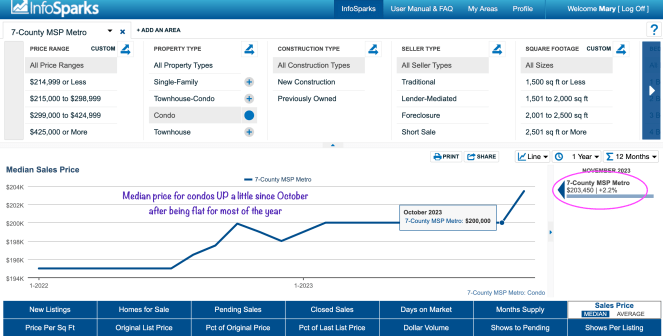
Data on Condos and Townhomes

If you have questions about the real estate market in the Twin Cities area – city or suburbs! – reach out! I love to talk to people that meet me YouTube or the Blog!ย 
Mary

it’s me. ๐Ÿ™‚
Minnesota · Uncategorized

Minneapolis vs Saint Paul: a fresh look after 8 years

Minneapolis established in 1867 and St. Paul established a bit earlier in 1854, often referred to as the Twin Cities, share many similarities but also have distinct differences that might sway someone’s preference for living in one city over the other. The downtowns are only 7 miles apart but there are a lot of differences between the two cities and I think a lot of it comes down to “vibe”. Like, maybe “chill” vs “not chill”.

Differences Between Minneapolis and St. Paul (Saint Paul was formerly known as PIGS EYE! Good decision to change that name!):

  1. Cityscape and Vibe: Minneapolis tends to have a more modern and cosmopolitan feel with a vibrant downtown area, skyscrapers, and a bustling arts and nightlife scene. St. Paul, as the state capital, has a more historic charm with beautiful architecture, cozy neighborhoods, and a quieter atmosphere.
  2. Cultural Offerings: Minneapolis is known for its thriving arts scene, hosting major theaters, galleries, and music venues like the Guthrie Theater and First Avenue. St. Paul, on the other hand, embraces its history and heritage with iconic landmarks such as the Cathedral of Saint Paul and the Minnesota History Center.
  3. Dining and Cuisine: Both cities offer diverse culinary experiences, but Minneapolis is often recognized for its trendy restaurants, food trucks, and fusion cuisine, catering to a more adventurous palate. St. Paul leans towards classic diners, family-owned eateries, and establishments that celebrate traditional comfort foods.
  4. Outdoor Recreation: Minneapolis is renowned for its chain of lakes, extensive parks, and bike-friendly trails, providing ample opportunities for outdoor activities like jogging, biking, and water sports. St. Paul boasts a scenic riverfront and more spacious parks, offering a quieter and more serene outdoor experience.
  5. Community and Lifestyle: Minneapolis is known for its diverse and cosmopolitan population, attracting people from various backgrounds and fostering a bustling city life. St. Paul, with its strong sense of community and neighborhood pride, tends to offer a cozier and more tight-knit atmosphere.
  6. Festivals: Saint Paul: Winter CarnivalSt. Patrick’s Day ParadeIrish FairTwin Cities Jazz FestHmong New Year Minneapolis: Twin Cities Pride, Loppet Ski Festival, Aquatennial, Basilica Block Party, U.S. Pond Hockey Championships
  7. LAKES: Saint Paul – 7 measly lakes. Minneapolis: coming in at 13 glorious and large lakes, earning one of it’s nicknames “The City of Lakes”.
  8. Population: St. Paul = 303,176 and Minneapolis = 425,096.
  9. Fortune 500 HQs: St. Paul has 4 and Minneapolis is the big poppa coming in at 6. The state of Minnesota is home to 15 Fortune 500 companies.
  10. Breweries: People like their beer in St. Paul – they have 17 breweries, but Minneapolis likes it more apparently, there are 32 breweries in Minneapolis. Try them all! But not on the same day.
  11. Colleges: The twin Cities is FULL of well-educated smarties, but more of them are larnin’ over in STP – there are 9 colleges located in the city limits of St. Paul while there are “only” 7 colleges in Minneapolis. Although, again, Minneapolis is home to the big dog, er, GOPHER, in the form of the University of Minnesota. The colleges on the St. Paul side of the river tend to be smaller, private colleges like St. Thomas, McCalester College and St. Catherines.

Some other differences of note:

  1. Housing Affordability and Age of Homes: St. Paul tends to have slightly more affordable housing compared to Minneapolis, with home prices typically being lower. Additionally, homes in St. Paul often lean towards older and more historic structures, offering a different architectural feel compared to the relatively newer housing options in Minneapolis
  2. Infrastructure and Winter Accessibility: Both cities boast skyway systems in their downtown areas, allowing residents and visitors to navigate the urban core without stepping outside, especially during harsh winter months. This feature provides convenience and shelter from extreme weather conditions, a significant advantage for those living and working in the downtown areas. The light rail does travel down University Avenue between both cities.
  3. Winter Maintenance: While the skyway system helps in navigating the winter, one common complaint (from ME) about St. Paul, is its snow plowing efforts. Prepare for some bumpy driving. Some residents have experienced “challenges” with the city’s snow removal services, resulting in difficulties commuting or driving during heavy snowfalls compared to Minneapolis, which might prioritize snow clearance more efficiently. But after living in Chicago for a long time where they take snow removal VERY seriously, I’m not giving either city a gold star.

Choosing Between Minneapolis and St. Paul with Additional Insights:

  • Choose Minneapolis If: You prefer a vibrant urban lifestyle with a bustling arts scene, trendy dining options, and a more modern cityscape. Minneapolis might be the ideal choice for those seeking a diverse, fast-paced city life with plenty of entertainment options and a youthful vibe.
  • Choose St. Paul If: You appreciate historic charm, a quieter pace of life, and a stronger sense of community. St. Paul might appeal to those who enjoy a more intimate city feel, where neighborhoods are tight-knit, cultural heritage is cherished, and a slower-paced lifestyle is embraced.
  • Consider St. Paul If: You’re looking for more affordable housing options with a touch of historical charm. St. Paul might appeal to those who prefer older homes and a more budget-friendly housing market. The skyway system can also be a significant advantage during cold winters if you work or spend considerable time downtown.
  • Consider Minneapolis If: You’re interested in newer housing options and a more efficient approach to winter snow removal. Minneapolis may be a better fit for individuals seeking a more modern living environment and possibly smoother winter travel experiences.
  • Winter Considerations: It’s important to note that while both cities offer skyway systems for winter convenience, St. Paul’s potential challenges with snow removal could impact commuting and daily activities during harsh winter conditions.

Ultimately, the choice between Minneapolis and St. Paul often comes down to personal preferences in terms of lifestyle, community, entertainment, and the overall atmosphere one seeks in a city to call home. Both cities offer unique experiences and opportunities, making the Twin Cities region a dynamic and diverse place to live.