“For some living in the warmer parts of the U.S., extreme weather tied to climate change is enough for them to consider cooler, safer climates.
No, Minnesota is not immune from the effects of climate change. But one Minnesota realtor says the state’s northern location is appealing appealing to her clientele from southern U.S.
“When you’re talking to people that are coming from all over the place, they do mention [Minnesota is] a more livable lifestyle that makes them feel safer,” said Mary Schumann, a realtor with Keller Williams Realty.
Schumann talked with MPR meteorologist Paul Huttner about the role climate change is having in people’s decision to move north.”
To hear the full conversation, click on the link below or subscribe to the Climate Cast podcast.
Here we are, diving into the heart of a Minnesota winter. If you’re considering a move here, you might imagine months of hibernation and freezing temps as the ultimate challenge. But I’m here to show you that cold doesn’t mean the end of the world. In fact, Minnesotans embrace winter with open arms and a full roster of activities to keep spirits high and bodies warm.
As a realtor in the Minneapolis area, I understand the concerns about moving to a state known for its snow and cold. I moved here from out of state myself, unsure of what to expect. But I’ve been pleasantly surprised by how much there is to love about winter here. If you’re curious about life in the Twin Cities, be sure to download my free relocation guide linked below.
Let’s explore some of my favorite ways to make the most of a Minnesota winter—from cozy indoor escapes to thrilling outdoor adventures.
Adopting a Winter Philosophy
In Nordic culture, there’s a philosophy that all seasons are wonderful if you’re dressed for them. Minnesotans have embraced this mindset, often referred to as “hoogah” (hygge), which means finding comfort and pleasure in simplicity. Instead of dreading the snow, we lean into it—and so can you.
Start your winter adventures with a cozy cocoa crawl paired with bookstore browsing. Many local coffee shops serve exceptional hot cocoa. Here are a few recommendations:
Minnesota is also home to fantastic independent bookstores. My favorite is Magers and Quinn in Uptown, but there are many others to explore in both Minneapolis and St. Paul. Make a day of it and discover your next great read!
Outdoor Winter Magic
Winter is a playground for kids and adults alike. Here are some highlights:
Ice Castles & Mazes: Every year, life-sized ice attractions pop up across the state. This year, the Ice Castle is at the University of Minnesota campus, and the Minnesota Ice Festival in Eagan features a record-breaking ice maze.
Snow Sculpting Championships: Held in Stillwater, this event draws artists from around the world to create breathtaking snow sculptures. Pair your visit with shopping or dining in Stillwater’s charming downtown, home to five candy stores—perfect for families!
For traditional outdoor fun, sledding, skating, and snowshoeing are always a hit with kids.
Feeling adventurous? Try fat tire biking, a growing winter trend. These bikes have large, nubby tires perfect for snowy trails. Rent one at a shop near Cuyuna Country State Recreational Area and explore groomed paths. Consider pairing it with a cabin rental for a memorable winter getaway.
Relaxation takes center stage with hot-and-cold plunges. Treat yourself to a spa day at Watershed Spa (Minneapolis) or head north to Cedar and Stone Sauna (Duluth) for a sauna session followed by a dip in Lake Superior. For a local option, try the Sauna Village during the Great Northern Festival.
For a luxurious staycation, book a room at the Hewing Hotel (Minneapolis). Their rooftop hot pool offers stunning city views and a perfect blend of hot and cold contrast. Afterward, enjoy a meal at Spoon and Stable or another downtown gem before retreating to your cozy room.
Winter is Wonderful
Minnesota winters are full of opportunities for fun and connection. From cocoa crawls and bookstore hunts to ice mazes and saunas, there’s something for everyone. Check out my other videos for even more ideas, and don’t hesitate to reach out with questions about moving to the Twin Cities. Winter isn’t just a season here—it’s a way of life we love.
Are you ready to embrace winter? Let me help you find your dream home in Minnesota, where every season offers its own unique charm.
My business is centered around helping people move to MN from other places. Of course I work with people that live here already, but because of my presence on YouTube I am usually discovered while people are looking into what it would be like to live in Minnesota, what the real estate market is like here, what they can expect to experience as newcomers and things like that.
A common thread when people are moving here is that they are leaving something behind (obviously!) but often the things they are leaving are related to climate. People in Texas, Florida and California that are desperate to escape the heat and the associated risks that come with it from power grids that can’t cope to fires in California.
If you’re interested in hearing from a client that came from the LA area of California to MN and my short interview you can click here.
And if thinking twice doesn’t do it, think a few more times—because you may be buying a house you’ll be stuck with for a LONG time.
I’m Mary Schumann, a realtor in the Minneapolis area. I help a LOT of buyers find the right home here. I’ve seen horror stories, analyzed inspection reports, and run the data on enough houses to confidently tell you to stay away from the following types of homes. Some of these tips may seem like common sense, but circumstances can sometimes push buyers to overlook red flags. Don’t be that buyer!
1. Homes With Obvious Flaws or Hazards
If a home has an obvious flaw that can’t be fixed—STOP and reconsider. Examples include:
Located on a busy street
Backing up to a railway
Next to a run-down mobile home park
The number one rule in real estate is location, location, location. If you buy in a noisy or undesirable area, you’ll limit your resale options significantly. Busy streets, railways, and unattractive neighbors often scare off buyers with kids or pets.
Pro Tip: It’s often better to buy the worst home in the best neighborhood than the best home in a questionable location.
2. Homes Without Basements
In Minnesota, basements are essential. We get tornadoes here, and having a safe place to go during severe weather is key. Basements also provide:
Extra storage
Space for a family room or workout area
Most buyers expect a basement, so skipping one could hurt your property value.
3. Homes With Water Problems
Watch out for homes at the bottom of a slope or in flood zones. These can lead to:
Damp basements
Water damage and mold
Look for signs of water staining or dampness, and make sure the home has a sump pump—a good sign the seller has mitigated any water issues.
Flood Zones Tip: Minnesota does well with water management, but always check flood maps if you’re near rivers or creeks.
4. Homes With Steep or Long Driveways
Minnesota winters mean snow and ice—and neither is fun on a steep or long driveway. Problems include:
Cars getting stuck or scraping low-clearance vehicles
Slipping on ice when walking up or down
Sunlight Tip: Driveways facing south or west get more sun, which helps melt ice and snow faster.
5. Poor-Quality New Construction Homes
Don’t get distracted by fancy finishes like granite countertops. Instead, focus on:
Durability of floors and carpet padding
High-quality mechanicals (furnace, AC, etc.)
Reputable builders with strong reviews
Minnesota has a 1-2-10 warranty on new construction:
1 year: Full coverage
2 years: Mechanical systems
10 years: Structural defects
Get a home inspection in the 11th month of your warranty to catch issues early.
6. Older Homes With Bad Roofs
Insurance companies may refuse coverage if a roof is in poor condition. Always check roof age and quality before buying an older home.
7. Homes at Dangerous Intersections or Curves
Avoid homes on T-intersections or tight curves. These locations often:
Attract traffic accidents
Shine headlights into your windows at night
8. Homes With HOA Restrictions
While Minnesota’s HOA rules are often less strict than other states, review them carefully. Minnesota law gives buyers a 10-day review period for HOA documents, including:
Rules and regulations
Budgets and expenditures
You can cancel your offer and get your earnest money refunded during this period if you don’t like what you see.
Final Advice: Don’t Skip Inspections
Yes, inspections are expensive, but they can save you from making costly mistakes. A high-quality inspector can uncover issues you may not be able to negotiate or fix later.
Work With a Realtor Who Tells It Like It Is
Thinking about buying a home? Find an agent who gives you honest guidance. My role is to arm you with the information you need to make smart decisions.
If you have questions, reach out! I love hearing from people who find me on online or on YouTube.
Today, I’m diving into the top 10 public school districts in the Minneapolis-St. Paul metro area according to Niche.com. This is a crucial topic for families considering a move to the Twin Cities metro.
School choice is a very personal thing, and while these schools have ranked highly on Niche.com, it’s important to visit the schools and ask questions pertinent to YOUR child, ensuring the decision fits your family best.
Minnesota stands out in its commitment to education. In May 2023, the state passed a massive $2.2 billion funding increase for public schools. This means the total budget now exceeds $23 billion dollars, Minnesota is dedicated to providing top-notch educational opportunities. The governor has publicly stated his goal of making Minnesota a great place to raise a family.
I feel like David Letterman…
At #10! Mahtomedi Public Schools. This is a smaller district on the Northeast side of the cities with only about 3200 students in total. The student to teacher ratio is 24:1 and it ranks highly in academics. It does have a “gifted program” and AP courses are offered.
At #9 is Rosemount-Apple Valley-Eagan public schools– This school district has a higher ranking in diversity of student population, the student teacher ratio is lower according to Niche.com stating that the ratio is 17 students to 1 teacher. This is an ENORMOUS school district with a lot of schools and almost 30,000 students. It’s located south of the cities. It has just about everything due to it’s large size.
At #8 Mounds View – Mounds view has a similar student teacher ratio as R-AV-E, but a much smaller student population at just under 12,000 students. Mounds view offers special ed, AP classes and a gifted program.
#7 Lakeville Schools– Lakeville is a smaller district with about 11,500 students and a 17:1 student teacher ratio. Lakeville is a growing community, there is a lot of new construction in this area, this formerly fairly rural area is becoming quite suburban. I do have a video about Lakeville that you can check out if you’d like. I have a playlist of MANY of the suburbs in the Twin Cities so you can check those out if you’re curious about various areas.
#6 Hopkins this is a small district of only about 7,000 students and it has a great student teacher ratio at 15:1. This is a community to consider if you like a small town feel but also want to be close to the actual city. I did a video on Hopkins and I will link to it here.
#5 Orono – this is a very small school district of less than 3000 students and is in one of the wealthier areas of the metro, bordering on Lake Minnetonka in places. This district scores well on Niche for everything except diversity.
#4 Edina – This a district of 8,400 students in a close in suburb of the Metro. I have done several videos showing neighborhoods in Edina, you can find them in my playlist and I’ll link to Indian Trails which is very close to the High School. I encourage you to look at the web sites of the various districts to see what they are highlighting – Edina has a VERY large offering for a district of this size. From the school district: “Edina Public Schools offers opportunities for students to deeply explore their interests, experience real-world learning, and creatively innovate. PreK-12 STEAM, travel-based learning, language immersion, talent development, and a virtual pathway are a few of the ways we individualize learning.”
#3 Eden Prairie – Eden Prairie offers a Spanish Immersion school as one of its options and also has gifted, AP and special ed. It has about 9,000 students and they say they have a 15 to 1 student to teacher ratio. This district is in an in demand suburb on the west of side of Minneapolis. From the school district: “We believe it is our purpose to create an environment of care and support where each student is inspired every day to recognize their skills and motivations, take ownership of their learning and explore their interests and passions.” I sat in on a presentation from the Eden Prairie schools and they seem to emphasize having kids that will be prepared to make decisions about what they want to do with their lives when leaving high school. For an overview of Eden Prairie you can check out my video profile of that suburb.
#2 Minnetonka – the district serves 10,900+ students and is the most sought-after district for open enrollment in MN with nearly 3,600 nonresident students. I believe that most of these non-resident students open enroll into Perpich Center for the Arts which is a public arts focused high school in Minnetonka. (I also did a video on open enrollment!) Minnetonka offers K-12 Chinese and Spanish Immersion, K-5 computer coding, AP and IB courses, collaborative research, advanced professional studies, online learning and award-winning arts and music programs. Ninety-eight percent of seniors graduate, 90% are college-bound. I do have a video for Minnetonka, too!
#1 Wayzata—The number one school district per niche.com is Wayzata schools. I hear from a lot of parents that want to get into this district because they have a good reputation and offer programs for special ed, AP and gifted. This district is large geographically and has 8 suburbs that feed into it on the north western side of the metro. It does have about 13,000 students.
An important aspect to understand is how school funding, often tied to property taxes, affects resources. Schools in areas with higher home prices (like Wayzata) generally have more resources. However, this doesn’t mean schools not on this list aren’t great options. The Twin Cities boast many excellent public schools.
Remember, if public schools aren’t the right fit for your family, the Twin Cities also offer a robust system of private schools, including religious and independent secular schools. Choosing the right school is about finding a place where YOUR child will thrive and grow.
Thank you for joining me! I love to talk to people that meet me on YouTube or the blog so please reach out with any questions or experiences you have with these schools.
What is happening in the Minneapolis area real estate market? I’ve been following several metrics over the past few years and there are a few that really stand out to me as indicative of how the market is doing, not just PRICE but what kinds of terms are included in winning offers and I will let you know which terms are revealing the current state of the market here.
I’m keeping my finger on the pulse of what is happening in the Twin Cities metro real estate market so you can be an informed buyer or seller.
The number one question that most people have about homes is whether or not prices are falling? I keep hearing this and for the purposes of this discussion I’m just going to look at the 7 county metro around Minneapolis and St. Paul and we can check the different housing types. The first is the most popular -SINGLE FAMILY HOMES. When I was digging into data for this update I decided to look at it over the past year and the past 10 years so that I can show you trend lines for both. I’m also going to differentiate by new construction and previously owned because new construction is at a vastly different price point as a whole.
Prices & time on market for existing homes
Metrics that I didn’t talk about in the video are how long houses are staying on the market these days. I do see houses sitting for quite a long time in certain areas and price points but the official numbers are charted here. The graph gives the impression of a big increase in time, but real numbers equate to only 3 more days.
New Construction
I’ll talk about pricing but for new construction I see a lot of opportunity for buyers here! Why? Builders have a lot of inventory right now. They have completed homes as well as homes that are underway with completion dates coming up. They need to get these homes off their books so they can continue to build and the interest rates have slowed things down for everyone, but the big builders are offering rate buy downs for buyers right now along with all kinds of other incentives, from appliance packages to closing costs.
Things to consider are that these homes are mainly being built in 3rd ring suburbs and exurbs so if proximity to the city is important you’re less likely to be able to get a new build – or at least one with a big builder that can offer these incentives. There are custom builds on lots here and there in the city.
You’ll see a slight dip in median price ($5000) from the beginning of the year. I have read in multiple sources that they estimate that it would take 10 years of building for the builders to catch up to demand for homes due to the after effects of the housing recession in 2008. We are still that far behind. New construction is showing over 6 months worth of supply but take this with a grain of salt because builders list homes that are TO BE BUILT – so they aren’t existing yet – along with those that they have ready for a buyer to move into.
New construction supply shows a buyers market! I haven’t seen this kind of number in a VERY long time. Ever?
Things are different when you look at previously owned homes. It is still a sellers market, although not the insane sellers market of a year or 2 ago. Homes still get multiple offers, the market is still moving just not at a runaway pace. Previously owned single family homes are sitting at about 1.3 months supply. So you can see the difference here.
WHY is it a seller’s market for existing homes and a buyer’s market for new constructions?
What leads to this? 80% of people with a mortgage on their home are paying less than 5% interest, 50% of them have a rate at less than 4%, they need a big incentive to list their homes and buy a different home with a mortgage at a higher rate. This really is one of those cases where as usual, of you have a good budget you are at an advantage because you can buy new construction and take advantage of the market and the incentives whereas those 2 things don’t exist as much for existing homes, prices are lower as a median but supply is lower too and you don’t get the builder buy downs. But you also don’t have to pay for a deck or the multitude of finishing touches that need to be added to new construction.
Price reductions
Housing inventory is dropping now as we get into the winter and holiday time, but the other thing that is slowing is PRICE REDUCTIONS – the percentage of them is reduced by about half of what it was 1.5 to 2 months ago, from 14% of listings to about 7%. Maybe agents and sellers are pricing correctly now, or maybe they understand that they may spend more than 5 minutes on the market?
Bank owned homes
Another statistic of note are the number of distressed or bank owned properties. We still have fewer than 100 listed out of about 6200 active listings. Less than 1.5%, other markets in the US are not faring as well. People here are still meeting their mortgage payments.
Offer terms that show a big shift
OK – a couple of other things that really stand out to me – the first is that sellers are contributing to buyers closing costs 43% of the time! that’s the highest percentage I can remember seeing. People including appraisal gap language on there offers has almost disappeared (although escalation clauses are still being included) but this makes sense when you see that most sellers are now seeing themselves getting about 99-100% of asking – this number was at 105% or more for a while and that was just crazy. Another option if you are in the previously owned category of home, if you find one you like and it has a motivated seller you could ask for them to do the rate buy down for you. Interest rates have been dipping back down, but it’s doubtful that they will ever get as low as they were during the pandemic. This will likely spur some more buyer activity as we head into spring.
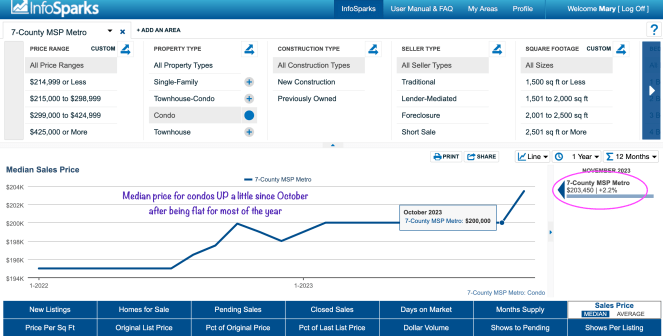
Data on Condos and Townhomes
If you have questions about the real estate market in the Twin Cities area – city or suburbs! – reach out! I love to talk to people that meet me YouTube or the Blog! Mary
Hey there, welcome back to my neighborhood exploration series! Today, we’re diving into a vibrant neighborhood in Minneapolis: Fulton. Nestled in the southwest part of the city, Fulton is an eclectic mix of urban convenience and historic home charm. Let me show you why this area is an absolute gem.
Click to see a video tour of the area!
Picture this: tree-lined streets, cozy sidewalks, and a thriving community vibe. Fulton boasts a prime location, bordered by 47th and 54th streets to the north and south, France Ave to the west, and Penn Ave to the east.
Easy Commutes!
And let’s talk about accessibility. Need to zip downtown? A mere 10-15 minute journey. Airport dash? You’re just around 20 minutes away from Terminal 1.
Where is Fulton?
Fulton is on the SW side of Minneapolis – you can see the airport on the south east corner of the city boundary.Prime location for pretty views and enjoying one of the best things about Minneapolis – all of the greenspace! + shopping, restaurants etc that are easy to get to on foot, bike, car or public transit.
The one negative… PLANES
Sure, there’s the occasional flight path over Lake Harriet…
😉
Trust me, the community here has adapted like pros, and it doesn’t dent the allure of this neighborhood one bit. But what makes this neighborhood truly special isn’t just its boundaries; it’s what’s within them.
Amenities
From Red Cow and Broders Pasta Bar to the charming antique shops and coffee spots at Xerxes Ave and 50th, Fulton is a hub for foodies and explorers alike. You’ll find yourself surrounded by all the amenities city dwellers crave, without sacrificing that cozy, welcoming atmosphere. Fulton is on the Minneapolis side of the 50th and France shopping and dining area. This is a sweet little hub that is perfect for hitting local shops, cozy restaurants or taking advantage of the newly renovated Edina Theater.
Now, let’s talk about the crown jewel of Fulton—Lake Harriet. This picturesque spot isn’t just a lake; it’s a community hub. Whether you’re riding the Grand Rounds 51-mile bike and walking path, attending festivals year-round, or enjoying lakeside dining at Bread and Pickle, there’s something magical about this place that draws people in.
But wait, there’s more! Beyond Lake Harriet, Fulton offers easy access to Minnehaha Creek and its scenic trails. Imagine biking or walking along a gurgling creek (or I’ll often see kids floating down the creek on inner tubes in summer!), it’s a lush greenspace connecting to Minnehaha Falls and West River Road, bordering the mighty Mississippi. As you make your way along this trail, you can feast on some eye candy of beautiful and gracious old homes lining the parkway.
Homes
Now, let’s talk homes. Fulton has a diverse range, from historic early 1900s residences to modern constructions. Whether you prefer a cozy vintage abode or a newly-built dream home, there’s something here for everyone. Prices vary, ranging from $475,000 to $1.4 million, reflecting the neighborhood’s diversity. If any were to come on the market by the lake you’d be paying over $2M. Fair warning.
Brain food
For bookworms, rejoice! Independent bookstores like Comma Books and the whimsical Wild Rumpus children’s store await nearby in the Linden Hills neighborhood. Plus, a stunning branch of the Hennepin County Library is just a stone’s throw away.
Schools
And for families, Fulton’s got you covered. Children will attend Lake Harriet Lower School, Anthony Middle and Southwest High School or a magnet school of their choice. educational options are plentiful.
Pershing Park is located within Fulton and with its sports fields, playgrounds, and wading pool—it’s a kid’s paradise!
So, whether you’re captivated by the serene beauty of Lake Harriet, the bustling local scene, or the fantastic housing options, Fulton offers an inviting blend of city living and community warmth.
Minneapolis established in 1867 and St. Paul established a bit earlier in 1854, often referred to as the Twin Cities, share many similarities but also have distinct differences that might sway someone’s preference for living in one city over the other. The downtowns are only 7 miles apart but there are a lot of differences between the two cities and I think a lot of it comes down to “vibe”. Like, maybe “chill” vs “not chill”.
Differences Between Minneapolis and St. Paul (Saint Paul was formerly known as PIGS EYE! Good decision to change that name!):
Cityscape and Vibe: Minneapolis tends to have a more modern and cosmopolitan feel with a vibrant downtown area, skyscrapers, and a bustling arts and nightlife scene. St. Paul, as the state capital, has a more historic charm with beautiful architecture, cozy neighborhoods, and a quieter atmosphere.
Cultural Offerings: Minneapolis is known for its thriving arts scene, hosting major theaters, galleries, and music venues like the Guthrie Theater and First Avenue. St. Paul, on the other hand, embraces its history and heritage with iconic landmarks such as the Cathedral of Saint Paul and the Minnesota History Center.
Dining and Cuisine: Both cities offer diverse culinary experiences, but Minneapolis is often recognized for its trendy restaurants, food trucks, and fusion cuisine, catering to a more adventurous palate. St. Paul leans towards classic diners, family-owned eateries, and establishments that celebrate traditional comfort foods.
Outdoor Recreation: Minneapolis is renowned for its chain of lakes, extensive parks, and bike-friendly trails, providing ample opportunities for outdoor activities like jogging, biking, and water sports. St. Paul boasts a scenic riverfront and more spacious parks, offering a quieter and more serene outdoor experience.
Community and Lifestyle: Minneapolis is known for its diverse and cosmopolitan population, attracting people from various backgrounds and fostering a bustling city life. St. Paul, with its strong sense of community and neighborhood pride, tends to offer a cozier and more tight-knit atmosphere.
LAKES: Saint Paul – 7 measly lakes. Minneapolis: coming in at 13 glorious and large lakes, earning one of it’s nicknames “The City of Lakes”.
Population: St. Paul = 303,176 and Minneapolis = 425,096.
Fortune 500 HQs: St. Paul has 4 and Minneapolis is the big poppa coming in at 6. The state of Minnesota is home to 15 Fortune 500 companies.
Breweries: People like their beer in St. Paul – they have 17 breweries, but Minneapolis likes it more apparently, there are 32 breweries in Minneapolis. Try them all! But not on the same day.
Colleges: The twin Cities is FULL of well-educated smarties, but more of them are larnin’ over in STP – there are 9 colleges located in the city limits of St. Paul while there are “only” 7 colleges in Minneapolis. Although, again, Minneapolis is home to the big dog, er, GOPHER, in the form of the University of Minnesota. The colleges on the St. Paul side of the river tend to be smaller, private colleges like St. Thomas, McCalester College and St. Catherines.
Some other differences of note:
Housing Affordability and Age of Homes: St. Paul tends to have slightly more affordable housing compared to Minneapolis, with home prices typically being lower. Additionally, homes in St. Paul often lean towards older and more historic structures, offering a different architectural feel compared to the relatively newer housing options in Minneapolis
Infrastructure and Winter Accessibility: Both cities boast skyway systems in their downtown areas, allowing residents and visitors to navigate the urban core without stepping outside, especially during harsh winter months. This feature provides convenience and shelter from extreme weather conditions, a significant advantage for those living and working in the downtown areas. The light rail does travel down University Avenue between both cities.
Winter Maintenance: While the skyway system helps in navigating the winter, one common complaint (from ME) about St. Paul, is its snow plowing efforts. Prepare for some bumpy driving. Some residents have experienced “challenges” with the city’s snow removal services, resulting in difficulties commuting or driving during heavy snowfalls compared to Minneapolis, which might prioritize snow clearance more efficiently. But after living in Chicago for a long time where they take snow removal VERY seriously, I’m not giving either city a gold star.
Choosing Between Minneapolis and St. Paul with Additional Insights:
Choose Minneapolis If: You prefer a vibrant urban lifestyle with a bustling arts scene, trendy dining options, and a more modern cityscape. Minneapolis might be the ideal choice for those seeking a diverse, fast-paced city life with plenty of entertainment options and a youthful vibe.
Choose St. Paul If: You appreciate historic charm, a quieter pace of life, and a stronger sense of community. St. Paul might appeal to those who enjoy a more intimate city feel, where neighborhoods are tight-knit, cultural heritage is cherished, and a slower-paced lifestyle is embraced.
Consider St. Paul If: You’re looking for more affordable housing options with a touch of historical charm. St. Paul might appeal to those who prefer older homes and a more budget-friendly housing market. The skyway system can also be a significant advantage during cold winters if you work or spend considerable time downtown.
Consider Minneapolis If: You’re interested in newer housing options and a more efficient approach to winter snow removal. Minneapolis may be a better fit for individuals seeking a more modern living environment and possibly smoother winter travel experiences.
Winter Considerations: It’s important to note that while both cities offer skyway systems for winter convenience, St. Paul’s potential challenges with snow removal could impact commuting and daily activities during harsh winter conditions.
Ultimately, the choice between Minneapolis and St. Paul often comes down to personal preferences in terms of lifestyle, community, entertainment, and the overall atmosphere one seeks in a city to call home. Both cities offer unique experiences and opportunities, making the Twin Cities region a dynamic and diverse place to live.
Hey, everyone! Today, we’re diving into the heart of Minneapolis to explore the eclectic and bustling Uptown neighborhood. Known for its diverse offerings, from historic single-family homes to modern condos, Uptown is a unique urban environment with a personality all its own. If you are considering a city neighborhood and looking for a bit of a faster pace this one could be for you.
Want to see it IRL?! (or virtually IRL?) take a peek.
Where is it?
Uptown is situated in the southwestern part of Minneapolis, and what sets it apart is its perfect blend of urban living and natural beauty. Whether you’re a foodie, a cyclist, or just someone who loves a vibrant city vibe, Uptown has something for everyone.
One of the standout features of Uptown is its accessibility. The neighborhood is connected to the Midtown Greenway bike path, making it a haven for cyclists. And if you prefer public transportation, you’re in luck – Uptown offers easy access to various transit options, making it a breeze to explore the city.
Photo from Metro Transit
Housing
Uptown boasts a diverse range of homes, from charming single-family cottages to grand Queen Anne Victorian mansions. Many of these single-family homes were constructed in the early 1900s, showcasing stunning woodwork and unique architectural details.
Prices for single-family homes in Uptown vary widely. You can find a cozy cottage for just under $300,000, perfect for those looking to add their personal touch. Meanwhile, if you’re in the market for something truly grand, Queen Anne Victorians can fetch over $2 million, especially if they’re close to the picturesque Bde Maka Ska.
Lakes!
Bde Maka Ska – the jewel of the Uptown neighborhood. This beautiful lake is part of the chain of lakes and serves as a hub of activity. During the summer, locals flock to the pavilion to enjoy a meal and a drink. The lake itself is a playground for water enthusiasts, offering sailing, kayaking, paddleboarding, and a sandy beach for those seeking some sun.
I took this from my bicycle in July of this year. LOVE this area!
If you’re more inclined towards low maintenance living, Uptown has a fantastic selection of condos. At the higher end, you’ll find modern penthouses with breathtaking views overlooking Bde Maka Ska, priced at over $2 million. For something unique, there’s a converted firehouse with over 3500 square feet, listed just over $1 million. But for most condo seekers, the sweet spot is between $119,000 and $250,000, with options in low-rise buildings dating back to the late 1950s and early 1960s.
Food!
Now, let’s talk about the culinary scene in Uptown because, trust me, your taste buds are in for a treat. One iconic spot that’s been a staple for years is Bryant Lake Bowl – it’s not just a bowling alley, but also a theater and a restaurant. This lively joint is the perfect gathering place from breakfast until the early hours of the morning.
If you’re craving Korean-American cuisine crafted by a James Beard Award-winning chef, look no further than Kim’s. Chef Ann Kim has truly created something special here. And for those with a hankering for authentic French bistro fare, Barbette is a must-visit. The ambiance is as delightful as the cuisine, making it a favorite among locals.
For a cozy dining experience with good food and a warm atmosphere, check out Bryant and Lake Cafe. Picture this: delicious food, a crackling fireplace, and an inviting ambiance – what more could you ask for? And remember, these are just three gems in a sea of fantastic dining options in Uptown.
Now, let’s shift gears a bit. Uptown is not just a feast for the palate but also for the mind. Magers and Quinn, an enormous bookstore, beckons book lovers with its vast collection of new and used books. Lose yourself in the aisles and spend an entire afternoon exploring literary wonders.
Strolling down the same street, you’ll find a beloved spice haven of the Midwest – Penzey’s Spices. Whether you’re a culinary expert or just starting your spice journey, this shop has everything you need to tantalize your Midwestern palate. It’s a must-visit for those looking to elevate their cooking game.
Uptown has a slightly bohemian feel, and part of that charm comes from its well-curated vintage shops. Explore these hidden gems to find unique pieces that tell a story and add a touch of history to your wardrobe or living space.
Now, let’s talk about the practical aspects of living in Uptown. For those who value literary exploration, you’ll be pleased to know that the Hennepin County Public Library has a branch right here in the neighborhood. It’s not just a place for books; it’s a community hub where knowledge flourishes.
Need to stock up on groceries? Uptown has you covered. There’s a Cub Foods for your everyday essentials and, if you’re in the mood for a more upscale shopping experience, Lunds and Byerlys is just a stone’s throw away. Whatever your culinary needs, Uptown has the grocery stores to meet them.
If you’re raising a family in Uptown, your children may attend Barton or Lyndale Elementary schools. As they progress, Susan B Anthony Middle School might be the next stop before moving on to Washburn High School. Uptown is also home to families who embrace educational diversity. Many high school students in the area explore magnet schools to tailor their education to specific interests. It’s not just about learning; it’s about finding a passion and nurturing it.
From the diverse culinary delights to literary escapes and spice adventures, Uptown Minneapolis truly is a neighborhood that has it all. Whether you’re a foodie, a bookworm, an avid bicyclist, water lover, or a vintage aficionado, Uptown welcomes you with open arms. If you’ve enjoyed this exploration, don’t forget to hit that like button, subscribe for more content, and let me know in the comments if you’ve visited any of these fantastic spots. Until next time, happy exploring!
We all love a list and Minnesotans LOVE to rank on a list!
US News and World Report has ranked MN as the 5th best state in the US in which to live.
Coming in first would obviously be better and the transplanted Minnesotan in me doesn’t even want to look at who beat us (it’s UTAH?!?! WHUT?), I just want to join my fellow North Star state residents in the chest thumping a bit.
If you’re thinking about moving to the 5th best state in the US (according to US NEWS I’m surprised there isn’t an uprising of Minnesotans protesting this ranking) I do have a free relocation guide you can download, just click that link.
What inspired them to rank MN so highly? (but not high enough!) The rankings are based on criteria like the economy, education, fiscal stability, health care, infrastructure, natural environment and opportunity.
I’m going to hit these in order and give some context around what US News decided and why they may need to re-evaluate in the future.
Theeconomy includes things like job growth, unemployment rate, and labor force participation as well as the business environment. Minnesota ranked 15th in the nation by this metric.
I don’t know when they did that ranking but I just checked the unemployment rate here and we are at 2.8%, so Minnesota is HIRING. If you’re looking for job opportunities this is a good place to look. We are also the HQ for 12 Fortune 500 companies and I believe that is the highest number for a mid-sized city. We are lucky in that our economy is very diverse and we aren’t tied to the fortunes of any one industry.
The state legislature JUST passed a 2.2 BILLION dollar funding bill in support of k-12 education in MN. A big component of this bill is a change in the way that education is funded, it ties funding to inflation so that education funding stays somewhat more current. It will be interesting to see how these changes affect the student outcomes and if it translates in the rankings later on.
Fiscal Stability
Again – a curious ranking at 21! We had a budget surplus of 17.5 BILLION dollars. The rankings looked at the ability of a state to meet their short and long term fiscal obligations. One thing we may have gotten dinged on was that a bonding bill at the super low interest rates last year did not pass.
We ranked 15th for health care. U.S. News examined metrics reflecting health care access, health care quality and public health outcomes. We ranked very well on mental health, we have low infant mortality, low obesity, low smoking rate, low mortality rates and a low suicide rate.
We ranked #1 for infrastructure! We’re number 1, we’re number 1! This metric takes into account metrics such as a state’s use of renewable energy, the quality of its roads and bridges, and its residents’ access to high-speed internet. The state of MN is focused on renewable energy and providing high speed internet access to everyone in the state. The legislature just passed major investments in both and the state has set the goal of
establishing a standard to achieve 100% carbon-free electricity and 55% renewable electricity by 2040.
adapting our grid through transmission upgrades to enable greater reliability and renewable energy access and integration.
improving building codes and standards so that all new commercial and large multi-family buildings produce net-zero greenhouse gas emissions by 2036.
This takes into account air and water pollution. Not bad for an overall ranking, MN is trying to mitigate this and there are ongoing disputes about mining in Northern MN and what it does to the water.
The opportunity category encompasses metrics reflecting economic opportunity, affordability and equality within a state. This category focuses on gender and racial equity and access to education, the ability to achieve equal pay and the ability to access adequate housing.
When they look at these as a whole we end up at #5 in the nation! I’ll take it! Will you? If you have questions about anything related to living in or moving to MN, reach out. I love talking to people who meet me on YouTube or the blog!